
Bad news can shake our beliefs. Here are 5 tips to get back on track.
We are meaning-makers. We like things to make sense. We believe in religions that provide an account for why the world is the way it is. We pursue goals that fit our conceptions of ourselves in the world. We even prefer things that “make sense” to things that don’t: for example, a marker set with a single pen of each color, as opposed to a set with an extra red pen (i.e., the set on the left as opposed to the set on the right— even though the one on the right has more pens total).
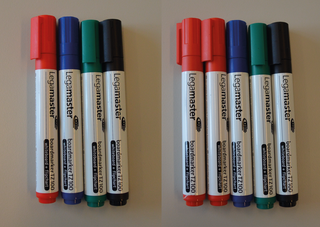
Source: Sarah Cotterill
But what happens when things don’t make sense? When one’s sense of meaning in life is jeopardized after, for example, a traumatic or unexpected event? After a mass shooting, or the death of a loved one, or a life-threatening diagnosis?
When meaning is already there—when the world already seems to make sense—there is no need to use our cognitive resources to search for it. But when meaning doesn’t come to us effortlessly, we use effort to find it.
Traumatic events trigger a more deliberate search for meaning precisely because they often don’t fit with one’s existing views of the world or one’s sense of self in the world.
And psychologists have known for many decades now that people find the experience of dissonance—when things don’t fit together in our minds—distressing. For example, we don’t like it when our attitudes aren't aligned with our behaviors (e.g., “french fries are bad for me, but I still eat them”)—to the point that we typically either change our attitudes (e.g., “I read somewhere that the potato has gotten a bad rap”), or our behaviors (e.g., quit eating french fries altogether).
The same is true for events that shake our worldviews—it can be frightening and uncomfortable to think that the world maybe isn’t as we envisioned it. And the literature points to a few strategies we use (consciously or unconsciously) to resolve those discrepancies—to make that discomfort go away.
Here are five examples:
1. First, we often reconstrue the meaning of the event so as to fit into our existing worldviews—what is called assimilation.
For example, in the aftermath of his cancer diagnosis, Jimmy Carter, a devoutly religious man, has publicly relied on his faith to help him make sense of his illness—what he calls his “latest adventure in life.” And a fellow member of his church congregation said this about his cancer: “When you get into a tough situation and you don’t know what God’s plan is, you should bow the knee.”
The critical part here is that cancer did not cause Carter nor his friends to revise their faith- in fact, it seems to have deepened it. They are hoping to understand how cancer fits into the plan for his life.
2. We also often change our worldviews to take into account the event—what is called accommodation.
We might conclude, for example, that while there is much good around us, the world is not as predictable as we might like to believe. That does not mean we have to adopt a pessimistic mindset. Rather, simply acknowledging that there is good and bad in the world might mean that when the bad does crop up it doesn't generate quite the same dissonance. (Incidentally, we also know that aspects of the brain respond more strongly to surprise than to the actual amount of “badness” wrapped up in any given event: the bad event you, to some extent, expect does not feel as unpleasant as the same event that you don’t see coming).
3. We engage in what’s called social comparison—reminding ourselves that, in certain respects, we might still be better off than many people in the world. Jimmy Carter also said, following his diagnosis, “I’ve lived a very good life.” In doing so, he seems to imply that there are others who have been less fortunate to this point—both a "prosocial" sentiment, and one that perhaps allowed him to feel more at peace with his own diagnosis.
4. We even engage in comparisons with ourselves. We might emphasize the fact that we’ve dodged outcomes even worse than the one’s we’ve been dealt—for example, cancers that could have been caught at later stages, or accidents that could have been more serious.
5. We often "reappraise" the event: we might search for silver linings—to see if we can find any good that has come out of a bad thing. For example, it is common to hear people (including myself) say that a certain traumatic event allowed them to become closer with their friends and family.
Through these processes, we often restore—and sometimes even enhance—our sense of meaning in life.
Oliver Sacks, on learning of his own cancer diagnosis, wrote in the New York Times, “Over the last few days, I have been able to see my life as from a great altitude, as a sort of landscape, and with a deepening sense of the connection of all its parts. This does not mean I am finished with life. On the contrary, I feel intensely alive, and I want and hope in the time that remains to deepen my friendships, to say farewell to those I love, to write more, to travel if I have the strength, to achieve new levels of understanding and insight.”
The idea that enhanced well-being can come from trauma is taken up in the literature on what’s called post-traumatic growth—and will be the topic of a later post! Source: https://www.psychologytoday.com/us/blog/the-science-adversity/201606/5-ways-find-meaning-in-life-following-adversity
--
Heintzelman, S.J., King, L.A. Meaning in life and intuition. Journal of Personality and Social Psychology, 110(3), 477-92.
Chater, N., & Loewenstein, G. (2016). The under-appreciated drive for sense-making. Journal of Economic Behavior & Organization, 126, 137-154.
Karlsson, N., Loewenstein, G., McCafferty, J., 2004. The economics of meaning. Nordic Journal of Political Economy, 30(1), 61–75.
Festinger, L. (1962). A theory of cognitive dissonance (Vol. 2). Stanford University Press.
